
How to Get Healthcare Without Insurance: A Practical Guide
Navigating the healthcare system without insurance can feel overwhelming, but it's important to know you have good options. You don't have to put your health on hold. There are many practical and affordable ways to get the care you need to live a long, healthy life.
From local community clinics and innovative telehealth services to programs designed to lower your costs, real solutions are within reach. This guide will walk you through how to take charge of your health, even when you're uninsured.
Your Guide to Healthcare When You're Uninsured
Think of this guide as your roadmap. We’ll cut through the confusion and provide clear, actionable strategies you can use today. We'll cover everything from finding an affordable local clinic to getting prescriptions without breaking the bank.
Whether your focus is on a specific wellness goal like weight management or you simply need a routine check-up, you can stay on top of your health.
You're Not Alone in This
First, it's helpful to know that you are not alone. In 2023, around 26 million Americans—that's 8% of the population—were without health insurance.
The numbers are even higher for certain groups. According to findings from KFF, part-time workers have an uninsured rate of 13.4%, much higher than their full-time peers. These aren't just statistics; they represent a shared challenge. Understanding this is the first step toward finding a solution.
Proactive Health is Your Best Strategy
Staying healthy isn't just about having an insurance card. In many ways, being uninsured can empower you to become a more resourceful and proactive manager of your own health. It’s all about knowing where to look and what to ask.
We’ll cover several key areas to get you started:
- Community Health Centers: These federally funded clinics offer care on a sliding scale based on your income.
- Telehealth Services: A convenient way to get virtual consultations for many health needs, right from your home.
- Prescription Savings Programs: Essential resources to drastically lower the cost of your medications.
- Urgent Care vs. ER: Knowing the difference can save you from a mountain of debt for immediate medical issues.
Telehealth has become a powerful tool for accessible care. It lets you connect with doctors without the travel, wait times, or high costs of an in-person visit. If you're new to the idea, our guide on how telehealth works is a great place to start. It’s an especially effective way to get consistent support for ongoing goals like managing your weight or focusing on long-term vitality.
To give you a clearer picture, here's a quick breakdown of your primary options.
Your Healthcare Options at a Glance
| Option | Best For | Potential Cost |
|---|---|---|
| Medicaid/CHIP | Low-income individuals, families, children, pregnant women, and adults in expansion states. | Free or very low-cost. |
| Community Health Centers | Primary care, dental, and mental health services for anyone, regardless of ability to pay. | Sliding-scale fees based on your income. |
| Telehealth Services | Non-emergency consultations, prescription refills, and follow-up appointments. | Often a flat, affordable fee per visit. |
| Urgent Care Centers | Immediate but non-life-threatening issues like sprains, colds, or minor cuts. | Less than an ER visit, but costs can vary. |
| Patient Assistance Programs | Access to brand-name medications directly from pharmaceutical companies. | Free or significantly reduced-cost prescriptions. |
This table is just a starting point. We’ll dive into the specifics of each option to help you find the best fit for your needs.
Finding Affordable Local and Community Care
When you don't have insurance, the search for medical care can feel overwhelming. But your best options are often right in your own community. Across the country, there are clinics and programs specifically designed to serve people based on their need, not their ability to pay.
These local resources are the backbone of accessible healthcare, offering everything from routine check-ups to support for your long-term wellness goals. Let’s walk through where to find them.
Start With Community Health Centers
Think of a Community Health Center (CHC) as your first and best stop. These clinics receive federal funding with one clear mission: to provide high-quality primary care in underserved areas. They are built to help people just like you.
The key benefit of a CHC is its sliding-scale fee system. This means what you pay is directly tied to your income and family size, making care truly affordable. They often provide medical, dental, and even mental health services all under one roof.
Finding a CHC is easy. The U.S. Health Resources & Services Administration (HRSA) has a simple HRSA Find a Health Center tool. Just enter your address to see a map of centers near you.
Practical Tip: If you've been monitoring your blood pressure at home and the numbers are a bit high, a Community Health Center is the perfect place to get it checked by a professional. You can establish care with a primary doctor who will work with you on a plan to manage it, all at a cost that fits your budget.
Look Into Free and Charitable Clinics
Beyond the federally supported CHCs, you’ll often find free and charitable clinics in your area. These are incredible resources, typically run by volunteer doctors, nurses, and staff who generously donate their time.
These clinics can be a lifeline, providing essential medical services for free or for a very small donation. While they may not have the extensive services of a larger CHC, they are invaluable for basic care, sick visits, and help with common health concerns.
So, how do you find them?
- Check with your local United Way.
- Search online for your state's free clinic association.
- Ask local churches or community outreach programs.
These groups are often well-connected to local support systems. For more ideas, our guide on how to get medical treatment without insurance has even more strategies to explore.
Don't Forget About Hospital Charity Care Programs
If you need hospital care—whether for an emergency or a planned procedure—there’s a powerful but often hidden option: charity care programs. By law, non-profit hospitals must offer financial assistance to patients who can't afford their medical bills.
These programs can dramatically reduce or even eliminate your bill, but you usually have to be the one to ask.
When you're at a hospital, visit the billing or financial assistance office. Ask them directly about their "charity care" policy and for an application. Having recent pay stubs or proof of income with you can help speed up the process. This single step can prevent a medical issue from becoming a financial crisis.
It's also worth noting that other specialized practices, like dentists, are creating new ways to access quality dentistry without insurance, so it always pays to ask about available options.
Using Modern Direct-to-You Healthcare
While community clinics are a fantastic local resource, technology has opened up a whole new world of convenient, direct-to-you healthcare. These modern services often sidestep the complexities of insurance, connecting you directly with medical professionals for clear, upfront prices.
This model is especially powerful if you have a specific goal in mind, like managing your weight or focusing on long-term wellness and longevity. You see the price, choose the service you need, and get care on your schedule.
The Rise of Telehealth Services
Telehealth is more than just a video chat with a doctor. It’s a total shift in how we access medical advice. You can handle consultations, get follow-up care, and even have prescriptions sent to your pharmacy without leaving home. This makes it an excellent option for anyone figuring out how to get healthcare without insurance, as the pricing is usually transparent and affordable.
This approach works wonders for specific health journeys. For example, if you’re focused on healthy living and weight management, a service like Blue Haven Rx can connect you with a medical team to discuss your options. This removes the financial guesswork that often prevents people from taking the next step toward their goals.
The need for accessible care is a massive global issue. It's jarring to realize that in 2023, a staggering 4.6 billion people—more than half the world's population—couldn't access essential health services. This fact really underscores why direct healthcare models are becoming so critical, as you can discover more about these global health challenges on Health Policy Watch.
Exploring Direct Primary Care
Another innovative model is Direct Primary Care (DPC). Think of it as a subscription for your health. Instead of paying for each visit, you pay a flat monthly fee directly to your doctor's office.
This single fee typically covers a surprisingly broad range of primary care services:
- Unlimited Office Visits: See your doctor whenever you need to, without a copay.
- Direct Communication: Many DPC doctors offer direct access via phone, text, or email.
- Longer Appointments: You get more time with your doctor for real conversations about your health.
- Basic Procedures: Many routine in-office procedures and basic labs are often included.
For someone who wants to be proactive about their health and longevity, a DPC model is invaluable. It fosters a true partnership with a doctor who gets to know your history and goals, all for one predictable price.
Getting Prescriptions Without the Hassle
One of the biggest headaches of being uninsured is the cost and complexity of getting prescriptions. Many direct-to-you services solve this by building it right into their process. Following a virtual consultation, any necessary prescriptions can be sent to your pharmacy or even shipped to your home.
This streamlined approach is a huge relief. If you're curious about the details, our guide on how to get a prescription online breaks down exactly how it works. It's a secure and convenient way to manage your health needs.
By tapping into these modern solutions, you can get high-quality care that fits your life and your budget. Learn more about how Blue Haven Rx can support your wellness goals today.
How to Lower Your Medical and Prescription Costs
Finding a doctor is one thing, but figuring out how to pay for it is often the real challenge. This is where you can become your own best advocate. You have more power than you think when it comes to medical bills, and a few smart moves can save you a significant amount of money.
This isn’t just a personal struggle; it’s a global one. Back in 2022, a staggering 2.1 billion people worldwide faced serious financial trouble because of medical costs. You can read more about these global healthcare findings from the World Health Organization) to see just how widespread this issue is.
Always Ask for the Cash-Pay Discount
Here's a simple trick that works time and again: providers often prefer cash. It cuts out the paperwork and delays that come with billing insurance. Because of that, many offer a significant "cash-pay" or "self-pay" discount.
Before you pay at a clinic, lab, or specialist's office, just ask: "What's the discounted price for paying in cash today?" You’d be amazed how often that one question can slash your bill. Don't be shy—this is a standard practice.
Negotiate Medical Bills After You Get Them
If you receive a surprisingly high bill, don't assume that number is set in stone. Medical billing can be complicated, and there's often room to negotiate, especially when you're uninsured.
Give the hospital’s billing department a call and calmly explain your situation.
- Request an Itemized Bill: First, ask for a detailed, itemized statement. This helps you spot errors or duplicate charges, which happen more often than you'd think.
- Offer a Lump-Sum Payment: If you can, try to settle the debt. Say something like, "I can pay $500 right now if you'll consider the bill paid in full." Many providers would rather get some money immediately than risk sending it to collections.
- Set Up a Payment Plan: If you can't pay it all at once, ask for a no-interest payment plan. This breaks the cost into manageable chunks.
People are getting creative to find affordable care. For major procedures, some are even exploring dental tourism in Mexico for significant savings compared to U.S. prices. It shows that thinking outside the box can really pay off.
Get Smart About Prescription Costs
Medication costs can be a huge hurdle without insurance, but there are fantastic ways to get those prices under control.
Your first move should be to check for Patient Assistance Programs (PAPs). These programs are run by drug companies to provide free or low-cost brand-name medications to people who qualify. A quick search on the manufacturer's website is all it takes to find an application.
Next, get familiar with prescription discount cards and apps like GoodRx. They are free and can unlock major discounts at most pharmacies. Make it a habit to compare prices before you fill a prescription.
Practical Tip: Never pay the sticker price for a prescription. Always check for a PAP, use a discount card, or ask the pharmacist if a cheaper generic version is an option. A few minutes of research can save you hundreds.
Finally, consider services that offer compounded medications, especially for goals like weight management or longevity, which insurance rarely covers anyway. Platforms like Blue Haven Rx provide clear, upfront pricing for treatments such as GLP-1 medications. You can learn more in our guide on how to get medication without insurance.
Making Smart Choices for Urgent and Preventive Care
When you're sick or hurt, knowing where to go can protect both your health and your wallet. One of the most critical decisions is choosing between an urgent care center and a hospital emergency room (ER). They seem similar, but the difference in cost and care is staggering.
Think of an urgent care center as the go-to for problems that need attention now but aren't life-threatening. A sprained ankle, a nagging cold, or a minor cut that needs stitches are all perfect for urgent care. They bridge the gap between a primary doctor and the ER.
Urgent Care vs. The Emergency Room
The ER is built for true, life-threatening emergencies like chest pain, severe difficulty breathing, or signs of a stroke. If you go to an ER for a minor issue, you could end up with a bill that's up to ten times higher than what you would have paid at urgent care for the same treatment.
When you're uninsured, a decision like this can have financial consequences that last for years.
Urgent Care vs. Emergency Room: A Cost and Service Comparison
| Factor | Urgent Care Center | Hospital Emergency Room |
|---|---|---|
| Best For | Sprains, minor cuts, colds, flu, infections, rashes | Severe chest pain, trouble breathing, major trauma, stroke symptoms, uncontrolled bleeding |
| Average Cost (Uninsured) | Typically $100 - $250 per visit | Can easily exceed $1,000 - $3,000+ for a single visit |
| Wait Times | Usually under an hour | Can be several hours, as life-threatening cases are prioritized |
| Services Offered | X-rays, lab tests, stitches, treatment for common illnesses | Comprehensive diagnostic imaging (CT scans, MRIs), surgery, intensive care |
The bottom line is simple: if your condition feels life-threatening, go to the ER without hesitation. For almost everything else, urgent care is a much smarter financial choice.
This flowchart can help you visualize how to approach different medical costs and find the most affordable path.
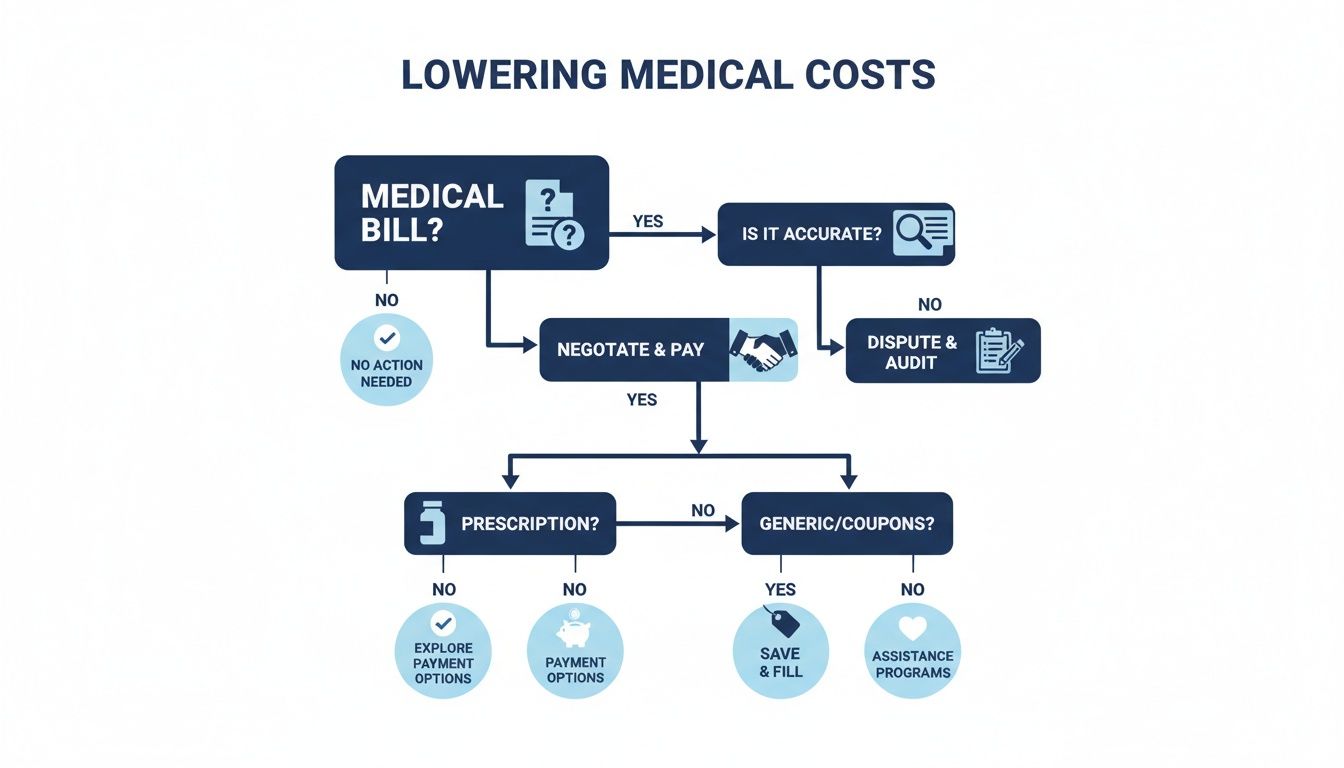
The key takeaway is that being proactive—whether negotiating a bill or finding prescription assistance—gives you a surprising amount of control over your healthcare expenses.
Investing in Long-Term Wellness
While knowing where to go for immediate needs is crucial, the real secret to managing your health without insurance is focusing on preventive care. Catching small issues before they become big, expensive emergencies is the best way to protect your health and your finances.
Preventive care is an investment, not an expense. A low-cost screening today can help you avoid a five-figure hospital bill tomorrow. It’s the most powerful financial tool you have for managing your long-term health.
So, where can you find affordable preventive services?
- Low-Cost Health Screenings: Community health centers and local health departments often provide screenings for blood pressure, cholesterol, and diabetes at a very low cost, or even for free.
- Vaccinations: Public health departments are your best bet for affordable flu shots and other essential vaccinations to keep you healthy.
- Proactive Health Coaching: Modern telehealth isn't just for sick visits. Many services offer access to health coaching and consultations focused on building sustainable habits around nutrition, exercise, and weight management.
This proactive support can be a game-changer. For example, if you're looking to start a weight management journey, a service like Blue Haven Rx can connect you with medical professionals to build a personalized plan. You can take a free quiz to see what options might be a good fit.
Putting It All Together: Your Healthcare Action Plan
Feeling overwhelmed by healthcare options without insurance is normal. The good news? You now have a practical game plan. Let's walk through the exact steps to take so you can feel confident and in control of your health.
It all starts with what's available right in your community. Think of it as building your personal healthcare toolkit.
Your Immediate Checklist
-
Find a Community Health Center Nearby: Your first stop should be the HRSA Find a Health Center tool. These centers are everywhere and are set up to offer affordable primary and preventive care on a sliding scale based on what you can afford.
-
Search for Free and Charitable Clinics: Do a quick online search for your state’s free clinic association. You might be surprised to find clinics staffed by volunteers that can help with basic medical needs at no cost.
-
Get Ready for a Telehealth Visit: For many common issues, virtual care is an amazing option. Services like Blue Haven Rx are built for this, connecting you directly with doctors for specific health goals without the insurance hassle.
Once you have a list of places to go, your next focus is making it affordable. Knowing how to get healthcare without insurance really comes down to being your own advocate.
Practical Tip: Always ask about payment options upfront. A simple question like, "Is there a discount for paying in full today?" can save you a surprising amount of money.
Finally, shift your mindset to long-term wellness. Staying on top of preventive care and building healthy habits is your best strategy for avoiding big medical bills and living a long, vibrant life.
If managing your weight is a priority for your health journey, now is the perfect time to see what’s available. Take our free online quiz to discover how Blue Haven Rx can support you with personalized care.
Answering Your Top Questions
It's normal to have questions when figuring out healthcare without insurance. Here are clear, practical answers to some of the most common concerns.
Can I Still Get Care for a Chronic Condition?
Yes, you absolutely can. Managing conditions like diabetes, high blood pressure, or asthma without insurance is doable, though it may take a bit more planning.
Your best starting point is a Community Health Center. They are designed to provide ongoing primary care and base their fees on your income, making consistent treatment more affordable.
Telehealth is another great option for regular check-ins and prescription management. For the medications themselves, be sure to look into Patient Assistance Programs from drug companies and always use a prescription discount card to lower your costs.
What Should I Do in a Medical Emergency?
If you are in a life-threatening situation, go straight to the nearest emergency room. Federal law requires hospitals to treat and stabilize you, regardless of your ability to pay. Your life is the priority.
Once you are stable, contact the hospital's financial assistance department. Ask them about their charity care program, payment plans, and whether they can negotiate the total bill. Never let fear of the cost stop you from getting emergency help.
Are Telehealth Doctors Real Doctors?
Yes, they are. Reputable platforms like Blue Haven Rx connect you with board-certified, state-licensed medical professionals. These are the same doctors and specialists you would see in a physical clinic. They can diagnose conditions, create treatment plans, and prescribe medication safely and legally.
Telehealth is a convenient way to get expert medical care, especially for specific wellness goals like developing a personalized weight management plan with GLP-1 medications or getting professional advice on healthy aging.
Telehealth cuts through the red tape. It gives you direct access to qualified medical expertise without the usual barriers of travel, long waits, and insurance headaches, putting you back in control of your health.
Is It Cheaper to Pay with Cash?
Often, yes. Many providers offer a "cash-pay" or "self-pay" discount because it saves them the administrative hassle of dealing with insurance companies.
It never hurts to ask. Just say, "What is the discounted price for paying in cash today?" This simple question can unlock significant savings on everything from lab work to doctor's visits.
Navigating healthcare on your own terms means being your own best advocate. Here at Blue Haven Rx, we're focused on empowering you with direct, affordable access to care for your wellness goals. When you're ready to take charge of your health, our team is here to support you.
Start your journey with a free online assessment.