
How to Calculate a Calorie Deficit: A Practical Guide to Sustainable Weight Management
The key to a successful calorie deficit is simple: consume fewer calories than your body uses each day. A sensible starting point is to determine your daily calorie needs and then subtract between 300 to 700 calories. This manageable reduction is the foundation for losing weight steadily and sustainably, without feeling deprived.
Your Practical Starting Point for Weight Management
If you've ever wondered how to calculate a calorie deficit for weight loss, you've come to the right place. Creating a calorie deficit is the core principle behind nearly every effective weight management plan. It signals your body to begin using stored fat for energy. This guide will walk you through the process, from understanding your body's baseline energy needs to setting up a deficit you can stick with for the long haul.
We will break down the numbers and provide practical advice to help you build a plan that truly works for you. This is about empowering you with the knowledge for long-term success, especially if you're navigating the metabolic shifts that often come with age. For more insights, our guide on how to start a weight loss journey is a great resource.
Before we dive into the calculations, here’s a quick overview of the steps we'll cover.
Your 4-Step Calorie Deficit Calculation Overview
Here’s a summary of the essential steps to calculate your personal calorie deficit for healthy and sustainable weight management.
| Step | What It Means | Why It's Important |
|---|---|---|
| 1. Find Your Baseline | Calculating your Basal Metabolic Rate (BMR)—the calories your body burns at rest. | This is the foundation of your total energy needs and is unique to you. |
| 2. Add Your Activity | Determining your Total Daily Energy Expenditure (TDEE) by factoring in daily movement. | This gives you a realistic estimate of the total calories you burn each day. |
| 3. Create a Deficit | Subtracting a moderate number of calories (e.g., 500) from your TDEE. | This creates the necessary energy gap for your body to start using stored fat. |
| 4. Track & Adjust | Monitoring your progress and making small changes to your plan as your body changes. | Your calorie needs shift as you lose weight, so adjustments ensure continued success. |
Each step builds on the last, giving you a complete framework for creating a sustainable plan that aligns with your health and longevity goals.
Finding Your Body’s Daily Calorie Needs
Before you can create a deficit, you need a clear starting point. Think of it like planning a road trip; you need to know where you are on the map before you can chart a course to your destination. In weight management, your starting point is your Total Daily Energy Expenditure (TDEE)—the total number of calories your body burns in a 24-hour period.
To find your TDEE, we'll look at two key factors: your metabolism at rest and your daily activity level. Understanding this is the foundation of any successful weight loss strategy. A practical guide to calculating energy expenditure can also provide helpful insights.
First, Your Resting Metabolism (BMR)
Even when you're completely at rest, your body is hard at work. It's constantly burning calories to keep your heart beating, lungs breathing, and cells repairing themselves. This baseline energy use is known as your Basal Metabolic Rate, or BMR.
Think of your BMR as your body's "cost of living." It accounts for the largest portion of your energy expenditure, typically making up 60-70% of the calories you burn every day. For a deeper dive, read our article explaining what Basal Metabolic Rate is and why it matters.
The flowchart below shows how understanding your BMR is the crucial first step on the path to reaching your weight management goals.
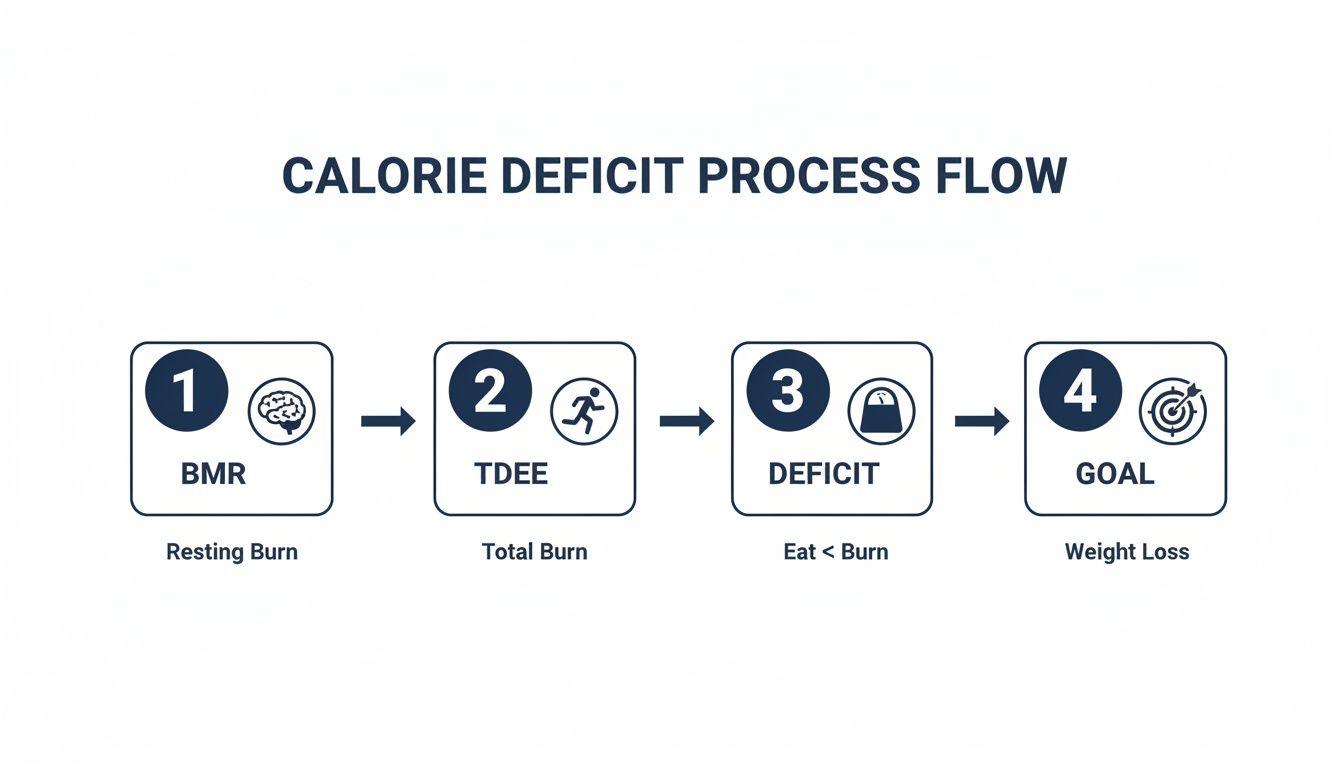
As you can see, everything starts with your body's baseline needs. From there, we add in activity, create a smart deficit, and finally, work toward your target weight.
Now, Let's Calculate Your Daily Needs With TDEE
Once you know your BMR, it's time to account for all your daily movement—from walking to your car to a structured workout. We do this by multiplying your BMR by an "activity multiplier" to find your TDEE. This final number gives you a much more realistic picture of your true daily calorie burn.
A trusted method for this is the Mifflin-St Jeor formula. It’s widely considered one of the most accurate ways to estimate your resting metabolism before adding your activity level.
Let's look at a practical example. Imagine a 55-year-old woman who is 5'4" (162 cm) and weighs 190 lbs (86 kg). Her calculated BMR, or resting metabolism, would be around 1,400 calories per day.
Now, let's add her activity. If she has a desk job and doesn't exercise much (sedentary), we'd multiply her BMR by 1.2, giving her a TDEE of roughly 1,680 calories. But if she’s moderately active and works out 4-5 days a week, her TDEE jumps to 2,170 calories. That's a significant difference that highlights why personalization is key.
Here are the standard activity multipliers to find your TDEE:
- Sedentary: Desk job with very little or no exercise. (BMR x 1.2)
- Lightly Active: Light exercise or a job with some movement 1-3 days a week. (BMR x 1.375)
- Moderately Active: Moderate exercise 3-5 days per week. (BMR x 1.55)
- Very Active: A physically demanding job or hard exercise most days of the week. (BMR x 1.725)
This TDEE number is your "maintenance" level—the calories you would consume to stay at your current weight. With this powerful information, you are now ready to create a smart and effective calorie deficit.
Creating a Calorie Deficit That Actually Works
You've done the foundational work and calculated your Total Daily Energy Expenditure (TDEE). Now for the most important step: creating a calorie deficit that is both effective and sustainable. This isn't about a crash diet or an outdated, one-size-fits-all rule. It’s about building a smart, personalized strategy that delivers lasting results without making you miserable.

Why the 3,500-Calorie Rule Is Outdated
For decades, the standard advice was that a 3,500-calorie deficit equals one pound of fat loss. This led to the popular "cut 500 calories a day to lose a pound a week" rule. While it sounds simple, our bodies are far more complex than a basic calculator.
Modern research shows this old rule is flawed. When scientists monitored people in controlled settings, they found that a 500-calorie daily cut often led to only about half the expected weight loss over time. This is due to metabolic adaptation. Your body is smart; when it senses a significant drop in calories, it becomes more efficient and burns less, slowing progress and leading to frustrating plateaus.
A better approach: Think in terms of a percentage of your total daily calorie needs, not a fixed number. This creates a personalized plan that works with your body’s unique metabolism.
Finding Your Sustainable Deficit
Instead of arbitrarily cutting 500 calories, aim for a deficit of 15-25% of your TDEE. This moderate range is the sweet spot for sustainable weight management. It helps preserve muscle mass, keeps hunger manageable, and avoids the dramatic metabolic slowdown that plagues overly aggressive diets.
You can use a reliable calorie deficit calculator to find your number, but the math is simple.
Let's walk through an example:
- Your TDEE is 2,200 calories.
- You choose a 20% deficit: 2,200 x 0.20 = 440 calories.
- Your new daily calorie target is: 2,200 - 440 = 1,760 calories.
This target is tailored specifically to your body's energy needs, making it a much more reliable path to steady, long-term fat loss.
Choosing Your Daily Calorie Deficit
The right deficit for you depends on your goals, lifestyle, and how your body responds. Here’s a quick guide to help you decide where to start.
| Daily Deficit | Approximate Weekly Loss | Best For |
|---|---|---|
| 15% of TDEE | 0.5 - 1 pound | A slower, highly sustainable approach that minimizes hunger and is easier to maintain long-term. |
| 20% of TDEE | 1 - 1.5 pounds | The "sweet spot" for many, offering steady, noticeable progress without feeling overly restrictive. |
| 25% of TDEE | 1.5 - 2 pounds | A more ambitious goal that can yield faster results but may require more discipline and careful planning. |
Choosing a percentage-based deficit helps create a plan that aligns with what is a healthy rate of weight loss and supports your overall well-being. This method is about more than just losing weight; it’s about building healthier habits that contribute to a longer, healthier life.
Even with the best calculations, managing hunger can be a challenge. If you find that sticking to your deficit is a constant struggle, it’s important to know there are tools available to support you.
When Your Body Needs Additional Support
Even when you've done the math perfectly, sticking to a calorie deficit can feel like an uphill battle. This is a common experience, especially for those of us over 45 dealing with hormonal shifts or a slowing metabolism. You might find that a moderate 20% deficit feels nearly impossible to maintain because of persistent hunger.
When this happens, it’s crucial to know that you have options for support. It’s not about a lack of willpower; it’s about using modern science to help your body work with you.
How Medical Support Can Bridge the Gap
This is where treatments like prescription GLP-1 therapies can be transformative. They are designed to address the biological hurdles that make weight loss so challenging for many.
These therapies work by influencing key hormones involved in metabolism and appetite regulation. By slowing digestion and sending powerful "I'm full" signals to your brain, they can make sticking to your calorie target feel much more natural and manageable.
This support is not a replacement for healthy habits—it's a way to make those habits sustainable. When you aren't fighting overwhelming cravings, you have the mental energy to build a better relationship with food and achieve goals that once felt out of reach. Suddenly, that calculated 20-25% deficit transforms from a daily struggle into a comfortable, achievable target.
Think of it this way: Your calorie deficit calculation is the roadmap. Medical support like GLP-1s can be the vehicle that helps you navigate the journey smoothly, especially through the rough patches.
A Smarter, Modern Approach to Weight Management
The science of weight management has evolved significantly. The old "3,500-calorie rule," introduced in 1958, suggested a simple energy exchange. But by the 1970s, experts were already highlighting its flaws. They realized that as you lose weight, your metabolism adapts and slows down, making that simple math unreliable for long-term predictions.
Understanding this evolution is key to setting smarter, more dynamic goals. You can learn more about how the scientific understanding of calorie deficits has changed over time and why old rules no longer apply.
For many, pairing a well-calculated calorie deficit with medical support offers a more predictable and successful path to long-term health. If you feel that persistent hunger or metabolic roadblocks are holding you back, it may be time to explore all the tools available. You can find more information in our library of educational articles or take our simple quiz to see what personalized options may be right for you.
How to Track and Adjust Your Plan for Lasting Success
Calculating your starting calorie target is a huge step, but it is just the beginning. Your body is incredibly adaptive, so your plan needs to be flexible too. This isn't about following a rigid diet; it's about creating a responsive approach that supports your long-term health and wellness.

Tracking your progress is essential, but it’s important to look beyond the number on the scale. That number can fluctuate daily due to water retention, hormones, or even a salty meal. True, lasting progress often reveals itself in other ways first.
Look Beyond the Scale
To get a complete picture of your success, incorporate a few other tracking methods. These can show you that you're making real progress long before the scale cooperates.
- Body Measurements: Use a soft measuring tape to check your waist, hips, and thighs once a month. Losing inches is a fantastic sign that you're losing body fat, even if your weight hasn't changed.
- Progress Photos: Snapping a quick front-and-side photo every few weeks can be a powerful motivator. You’ll see changes in your body composition that the mirror doesn't always show day-to-day.
- How Your Clothes Fit: This is often the most rewarding measure of success. When that pair of jeans you've kept in the back of your closet finally fits comfortably, it's a real-world win that proves your efforts are working.
We explore these techniques further in our guide on how to measure body fat percentage, which offers a more meaningful way to track your health progress.
Know When to Recalculate and Adjust
As you lose weight, your body’s energy needs decrease. A lighter body simply requires fewer calories to function. This means the calorie goal that helped you lose the first ten pounds will eventually become your new maintenance number, leading to the dreaded weight-loss plateau.
Key Takeaway: A good rule of thumb is to recalculate your TDEE and adjust your calorie target after every 10-15 pounds of weight loss. This keeps your plan aligned with your body’s changing needs and prevents stalls in your progress.
Hitting a plateau isn't a sign of failure; it’s a sign of success! It means you've made significant progress, and a simple adjustment is all that’s needed to keep moving forward.
Remember, consistency is more important than perfection. If you have a day where you go over your target, don't worry. Just get back on track with your next meal. This is a journey, and a flexible, forgiving mindset is what builds healthy habits for life.
If you’re ready to build a plan that truly supports your long-term health and vitality, explore your options with Blue Haven Rx.
Answering Your Questions About Calorie Deficits
Starting a new health plan naturally brings up questions. This is a positive sign—it means you are thoughtfully engaged in your wellness journey. Let's address some of the most common questions people have when starting a calorie deficit.
How Often Should I Recalculate My Numbers?
This is an excellent question. It's wise to recalculate your numbers after every 10 to 15 pounds of weight loss.
As your body gets lighter, its energy needs decrease—your Basal Metabolic Rate (BMR) goes down. Sticking to your original calorie target without adjusting is a common reason for hitting a weight loss plateau. A quick recalculation ensures your deficit is right for your current body, helping you maintain steady progress.
Will a Bigger Deficit Lead to Faster Weight Loss?
While it’s tempting to slash calories for quicker results, this approach often backfires. A very large deficit—anything over 1,000 calories or more than 30% below your daily needs—is not recommended without medical supervision.
Going too low can lead to significant muscle loss, nutrient deficiencies, and deep fatigue. Your metabolism may also slow down dramatically to conserve energy, making it harder to maintain your results in the long run.
Expert Tip: A moderate deficit of around 300-700 calories (or 15-25% of TDEE) is the sweet spot. It's safe, sustainable, and more effective for long-term fat loss because it helps preserve muscle mass and energy levels.
I’m in a Deficit, So Why Isn't the Scale Moving?
This is one of the most common frustrations. First, be honest with your tracking. It's easy to underestimate portion sizes or forget small additions like creamer in your coffee or a handful of nuts.
Also, remember that weight fluctuates. Hormonal shifts and water retention can easily mask fat loss on the scale for days or even weeks.
If you’ve been consistent for several weeks with no change, it may be time to speak with a professional. Other factors could be at play, and a medically guided approach, potentially including support from therapies like our GLP-1 therapies, can make a significant difference.
Do I Have to Be Perfect with My Tracking Every Single Day?
Absolutely not. The goal is consistency, not perfection.
Life is meant to be lived. There will be birthday parties, holidays, and days where you just feel hungrier. Don't let one "off" day derail your progress. Focus on your weekly average rather than hitting a perfect number every 24 hours. Lasting success comes from building flexible, healthy habits, not from following rigid rules.
At Blue Haven Rx, we believe in a supportive, science-backed approach to weight management and healthy living. If you’re ready for a plan that works with your unique body and lifestyle, we’re here to guide you.
Start your journey today by taking our quiz.