
What is Basal Metabolic Rate and How Does It Affect Your Weight?
Your basal metabolic rate (BMR) is the number of calories your body needs to perform its most basic, life-sustaining functions while you're at rest. Think of it as your body's engine idling—the energy required for breathing, circulating blood, and keeping your organs working, even when you're not moving a muscle.
Understanding this number is a crucial first step in managing your weight, boosting your energy, and promoting healthy aging.
Understanding Your Body’s Hidden Engine
Even when you are resting or sleeping, your body is always working. This quiet, continuous energy burn is your BMR, and it’s the largest component of your daily metabolism.
Surprisingly, this baseline activity can account for up to 70% of the total calories you burn each day. It's the foundation of your metabolic health. Knowing your BMR is key to creating a successful weight management plan, especially as you navigate the natural metabolic shifts that come with age.
Why Your BMR Matters for Weight Management and Longevity
Knowing your BMR gives you a powerful piece of information: your personal energy baseline. It tells you exactly how much fuel your body requires just to function, before you even get out of bed. This number is the foundation for a smart, sustainable nutrition plan tailored to your body, not a generic template.
A healthy, optimized BMR is closely linked to your overall well-being and longevity. Here’s why it’s so important:
- Efficient Calorie Burning: A higher BMR means your body is naturally more effective at burning calories around the clock, which is a great asset for maintaining a healthy weight.
- Preserving Muscle Mass: Muscle is metabolically "expensive"—it burns significantly more calories at rest than fat does. Building and maintaining it is one of the best ways to support your BMR as you age.
- Better Energy Levels: When your metabolic engine is running efficiently, you'll often experience more stable and consistent energy throughout your day, helping you feel your best.
To get the full picture, it helps to understand the broader concept of what is metabolic health. And if you're concerned that your metabolism isn't as robust as it used to be, you might recognize some of the common symptoms of a slow metabolism.
At Blue Haven Rx, we believe knowledge is the key to taking control of your health. Understanding your BMR is an excellent starting point for your wellness journey.
Decoding Your Daily Energy Burn: BMR vs. RMR vs. TDEE
When you start looking into metabolism, you’ll encounter a few similar-sounding terms: BMR, RMR, and TDEE. They all relate to the calories you burn, but they measure slightly different things. Understanding the difference is the first step toward creating a health plan that truly works for you.
Think of your body like a car.
Your Basal Metabolic Rate (BMR) is the energy your car uses while it's parked with the engine off. It’s the absolute bare minimum power needed for core systems. This is the energy your body needs for essential survival functions like breathing and cell production while in a deep, restful state.
Your Resting Metabolic Rate (RMR) is more practical. This is the energy your car burns while idling in the driveway—the engine is on, but you're not moving. It's measured under less strict conditions than BMR, making it easier to estimate. Your RMR is usually about 10% higher than your BMR and is often used for everyday health planning.
Finally, your Total Daily Energy Expenditure (TDEE) is the total fuel you burn all day. This is your BMR plus the energy you use for everything else—walking, working, exercising, and even digesting food. It’s the complete picture of your daily calorie needs.
A Quick Comparison Guide
To make it even clearer, let's break down these three key metrics side-by-side.
BMR vs RMR vs TDEE At a Glance
| Metabolic Rate | What It Measures | When It's Measured | Primary Use |
|---|---|---|---|
| BMR | The absolute minimum energy for basic life functions. | In a thermoneutral state, immediately after waking, and after an overnight fast. | Clinical and research settings; the theoretical baseline for metabolism. |
| RMR | The energy burned while at rest, but not in a basal state. | In a relaxed, resting state, without the strict fasting or sleep requirements of BMR. | Practical estimation for creating nutrition and fitness plans. |
| TDEE | The total calories burned in a 24-hour period. | Not measured at one time; it's a calculation of BMR/RMR plus all physical activity. | Setting daily calorie targets for weight loss, maintenance, or gain. |
This table shows why, for most of us, RMR and TDEE are the most useful numbers for real-world planning.
Visualizing Your Energy Breakdown
It's one thing to talk about these numbers, but seeing how they fit together really drives the point home. This diagram shows just how foundational your BMR is to your overall energy needs.
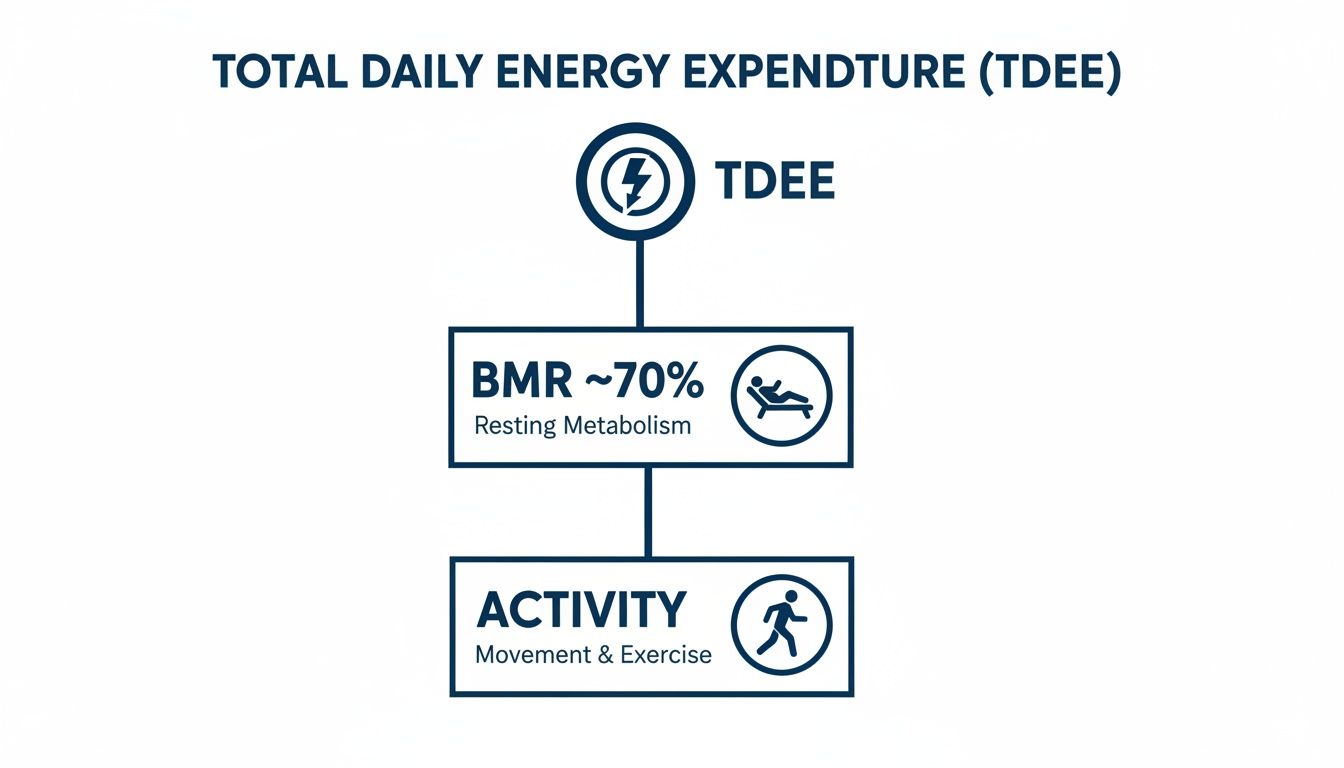
What's really striking is that your resting metabolism accounts for the lion's share—around 70%—of the calories you burn every single day. That's why understanding and supporting your BMR is such a powerful strategy for long-term health.
Putting It All Together for Your Goals
So, what do you do with this information? Knowing the difference helps you build a smarter, more personalized health strategy. Your BMR or RMR gives you the starting line, but your TDEE is the number you need to work with when setting calorie targets.
This knowledge is the foundation for creating a calorie deficit that leads to sustainable weight loss without making you feel deprived.
By understanding your TDEE, you can make informed choices about your nutrition and activity levels, ensuring you’re fueling your body correctly for your specific goals.
Once you have a good grasp of these concepts, you can plug your stats into a good online calorie calculator to get a solid estimate of your TDEE and start planning your next steps.
How to Calculate Your Basal Metabolic Rate
So, how do you figure out the BMR for your unique body? While the most precise measurement is done in a clinical lab, you can get a very accurate estimate at home using a trusted scientific formula. This number is the essential starting point for building a smarter, more effective health plan.
The two most common methods are the Harris-Benedict and the Mifflin-St Jeor equations. Modern research suggests the Mifflin-St Jeor formula provides a more accurate estimate for most people today. For that reason, it's our go-to for a reliable calculation.
The Mifflin-St Jeor Formula Explained
This formula might look a little complex, but it’s actually quite straightforward. It uses your sex, weight, height, and age to estimate your baseline calorie needs.
Here are the two versions of the formula:
- For Men: (10 × weight in kg) + (6.25 × height in cm) – (5 × age in years) + 5
- For Women: (10 × weight in kg) + (6.25 × height in cm) – (5 × age in years) – 161
Before you start, you’ll just need to convert your weight from pounds to kilograms (divide by 2.2) and your height from inches to centimeters (multiply by 2.54).
Let's Walk Through a Real-World Example
To make this crystal clear, let's calculate the BMR for a hypothetical 55-year-old woman named Susan.
- Her Age: 55 years
- Her Weight: 160 pounds (which is 72.6 kg)
- Her Height: 5' 6" (66 inches, or 167.6 cm)
Now, we’ll plug Susan’s stats into the women’s version of the formula, step by step:
- First, the weight part: (10 × 72.6 kg) = 726
- Next, the height part: (6.25 × 167.6 cm) = 1,047.5
- Then, the age part: (5 × 55 years) = 275
Finally, we just put it all together: (726 + 1,047.5) – 275 – 161 = 1,337.5
Susan’s estimated Basal Metabolic Rate is roughly 1,338 calories per day. This is the energy her body needs just to power her heartbeat, brain function, and breathing if she were to rest all day. It's a critical piece of the puzzle for her weight management goals. Keep in mind, this formula doesn't account for body composition, which is why it's also helpful to learn how to measure body fat percentage for a more complete picture of your metabolic health.
Your BMR is not your final daily calorie target. It's the foundational number upon which your total daily energy needs (TDEE) are built, factoring in your activity level.
Calculating this number yourself is incredibly empowering. It helps you move away from one-size-fits-all diet advice and toward a plan that respects your body’s individual needs.
Key Factors That Influence Your Metabolic Rate
Ever wonder why a friend can eat more than you without gaining a pound? The answer often lies in their basal metabolic rate. Your BMR is not a fixed number; it's influenced by a mix of factors—some you are born with and others you can actively manage.
Understanding these influences is the first step toward taking charge of your metabolic health. While you can't change your age or genetics, you have more control than you might think over other key areas.
Factors You Cannot Change
Some parts of your metabolic equation are simply part of your personal blueprint. Acknowledging them helps you focus on what you can improve.
- Genetics: Some people are naturally born with a faster or slower metabolism, thanks to traits passed down through their family.
- Age: It’s true—metabolism tends to slow down as we get older. After age 20, BMR often decreases by about 1-2% each decade. This is largely due to age-related muscle loss. You can discover more insights about how metabolism changes with age in this detailed study.
- Sex: On average, men have a higher BMR than women. This is because men typically have more muscle mass, which is a very metabolically "active" tissue.
- Height: Taller individuals generally have a higher BMR because a larger body requires more energy to function.
Factors You Can Influence
Here is where you take the driver's seat. By making conscious lifestyle choices, you can support and even boost your metabolic rate. This is especially important when navigating the metabolic shifts that come with life stages like menopause.
Your lifestyle choices are your most powerful tools. Simple, consistent habits in diet and exercise can significantly counteract the natural metabolic slowdown that comes with age.
Let's look at the key areas where you can make a real difference.
Building and Maintaining Muscle Mass
This is the "secret weapon" for your metabolism. Muscle tissue is far more metabolically active than fat tissue—it burns more calories, even when you're resting.
A pound of muscle burns roughly 6 calories a day at rest, while a pound of fat burns only about 2 calories. That difference adds up over time. Prioritizing strength training helps you build and hold onto this precious, calorie-burning tissue.
The Role of Hormones and Diet
Hormones act as messengers, directing everything from your mood to your metabolism. As hormones shift, especially during perimenopause and menopause, it can lead to a decrease in muscle mass and a slower BMR.
Your diet provides a powerful way to support hormonal balance. Getting enough protein is essential for repairing and building muscle. A well-balanced diet also gives your thyroid—the master gland of your metabolism—the nutrients it needs to function properly.
For those seeking additional support in managing metabolic changes and weight, our GLP-1 program offers a modern, science-backed approach.
If you’re ready to better understand your unique metabolic needs, a great first step is to take our quiz.
Why We Burn Fewer Calories Than Our Ancestors
Have you ever felt like managing your weight is tougher than it was for previous generations? You're not imagining it. Modern science is beginning to explain why the old advice to "just eat less and move more" feels incomplete.
Evidence suggests that people today may have a lower basal metabolic rate than our ancestors did, even when accounting for body size. This points to fundamental shifts in our environment and lifestyle that have quietly changed how our bodies burn energy.
The Modern Metabolic Slowdown
This gradual decline in our collective BMR has significant consequences for weight management. A major study that analyzed data from thousands of adults over a century found that our adjusted BMR has dropped, with a steep 14.7% decline in just the last 30 years. You can dive into the details by reading the full research about these metabolic changes.
This means your body, at rest, likely burns fewer calories than your grandparents' bodies did at your age. This can make maintaining a healthy weight more challenging.
What’s Behind This Change?
So, what's causing this metabolic shift? It seems to be a combination of modern factors.
- Changes in Our Food: Our diets are often filled with ultra-processed foods, which can be easier for our bodies to digest, meaning we use less energy to break them down.
- Reduced Physical Demands: Our daily lives are far less physically demanding than they once were. This can lead to less overall muscle mass, a key driver of resting metabolism.
- Environmental Factors: We live in climate-controlled environments. Our bodies no longer have to work as hard to stay warm or cool down, which reduces our daily energy burn.
Understanding this isn't about making excuses; it's about arming yourself with knowledge. It confirms that the challenges you face are real and rooted in our modern metabolic landscape.
This new reality underscores the need for smarter strategies designed for a 21st-century metabolism. If you’re ready to explore a modern solution, take our quick quiz to see how we can help.
Actionable Steps to Boost Your Basal Metabolic Rate
Knowing what BMR is gets you in the door, but the real power comes from knowing how to support it. While you can't change your age or genetics, you have significant control over lifestyle factors that can help maintain—and even increase—your resting metabolism. These are small, consistent investments in your body's long-term health and vitality.

These strategies aren't quick fixes. They are sustainable habits that work together to support your metabolic health for years to come.
Build and Preserve Lean Muscle
If there’s one powerhouse for boosting your BMR, it’s building muscle. Lean muscle is metabolically “active” tissue, meaning it burns more calories than fat, even when you're resting.
- Constant Calorie Burn: A pound of muscle burns about 6 calories a day to sustain itself, while a pound of fat burns only about 2 calories. That difference adds up.
- Counteracts Aging: We naturally lose muscle as we age, a process called sarcopenia. This is a primary reason BMR declines. Regular strength training is your best defense.
Aim for at least two strength training sessions per week. This could be lifting weights, using resistance bands, or doing bodyweight exercises. Consistency is the key.
Prioritize Protein in Your Diet
Protein is the building block for muscle. It also has a higher thermic effect of food (TEF), meaning your body burns more calories just digesting and processing it compared to carbs or fats.
By including enough protein with each meal, you give your body the resources it needs to build and repair calorie-burning muscle, while also giving your metabolism a small, immediate boost.
Focus on sources like lean meats, fish, eggs, dairy, and legumes. A simple tip is to include a protein source with every meal and snack. To dive deeper, you can learn more about how to speed up your metabolism in our detailed guide.
Optimize Your Sleep and Hydration
Never underestimate the power of the basics. Sleep and hydration are foundational to a healthy metabolism.
- Quality Sleep: Lack of sleep can disrupt key hormones that regulate appetite and metabolism. Aiming for 7-8 hours of quality sleep per night is crucial for keeping them in balance.
- Stay Hydrated: Your body needs water for nearly every metabolic process. Even mild dehydration can cause your metabolism to slow down. Keep a water bottle handy to stay on track.
These lifestyle adjustments are incredibly powerful. When combined with modern medical support, the results can be even more profound. Our programs are designed to work with these healthy habits, helping you manage your health and achieve your goals more effectively.
Got Questions About BMR? We’ve Got Answers.
We've covered a lot of ground—from what your BMR is to how you can calculate and support it. But it’s natural to have a few questions. Let’s tackle some of the most common ones.
Is It a Good Idea to Eat Below My BMR to Speed Up Weight Loss?
This is a common question, and the short answer is no, it's not a sustainable or healthy strategy. While you need a calorie deficit to lose weight, consistently eating below your BMR can cause your body to go into "conservation mode."
When this happens, your body may slow your metabolism down to conserve energy, which can lead to muscle loss and fatigue. This ultimately makes it harder to manage your weight in the long run. A better approach is to set your calorie target based on your TDEE (Total Daily Energy Expenditure), creating a modest and sustainable deficit.
How Reliable Are BMR Estimates from Fitness Trackers?
Fitness trackers are great for motivation and tracking trends. They use formulas with your height, weight, and age to give you a BMR estimate. However, it's important to remember that this number is an educated guess.
Think of your tracker's BMR as a useful starting point, not a perfect measurement. It's a great ballpark figure, but for a plan that's truly built for you, nothing beats talking to a healthcare professional.
Will My BMR Go Down as I Lose Weight?
Yes, and this is completely normal. As your body gets smaller, it requires less energy to maintain itself. This is a natural process called metabolic adaptation, and it's one reason people can hit weight loss plateaus.
This is why building or maintaining muscle through strength training is so critical during a weight loss journey. By preserving lean mass, you help offset the natural drop in BMR as you become leaner, supporting long-term success.
At Blue Haven Rx, we understand the science behind metabolic health. If you’re ready for a plan that works with your body, not against it, we're here to guide you. Take our quiz to get started on your personalized journey today.