
How to Overcome a Weight Loss Plateau: Reignite Your Results
It's a moment every person on a weight loss journey dreads: the scale just… stops. You’ve been doing everything right, the pounds were coming off, and then—nothing. For weeks.
First, take a deep breath. This is not a sign of failure. It's an incredibly common, almost predictable, part of the process. Your body is smart. It’s adapted to your new routine, and now it’s asking for a new challenge. Think of it less as a dead end and more as a pit stop to reassess the map.
Why Plateaus Happen and How to Move Past Them
This guide is your new roadmap. We’ll walk through practical, research-backed strategies to get the needle moving again, from simple tweaks in your diet and exercise to understanding how modern medical support can make a difference. Pushing through this stall is completely doable.
And you're in good company. Research from Australia's CSIRO, analyzing data from over 6,500 people, found that a staggering 85% hit a plateau. But here’s the encouraging part: the study also showed that two out of three of them went on to lose at least 5% of their body weight over the year. Persistence is key. You can read the full research about these weight loss findings for a deeper dive.
A plateau is your body’s way of showing it has successfully adapted to your new, healthier lifestyle. Now, it’s simply time to introduce a new, positive challenge to keep making progress toward your long-term health goals.
The path through a plateau often starts with frustration, but it needs to shift toward understanding and, finally, informed action. This isn’t about fighting your body; it's about working with it.
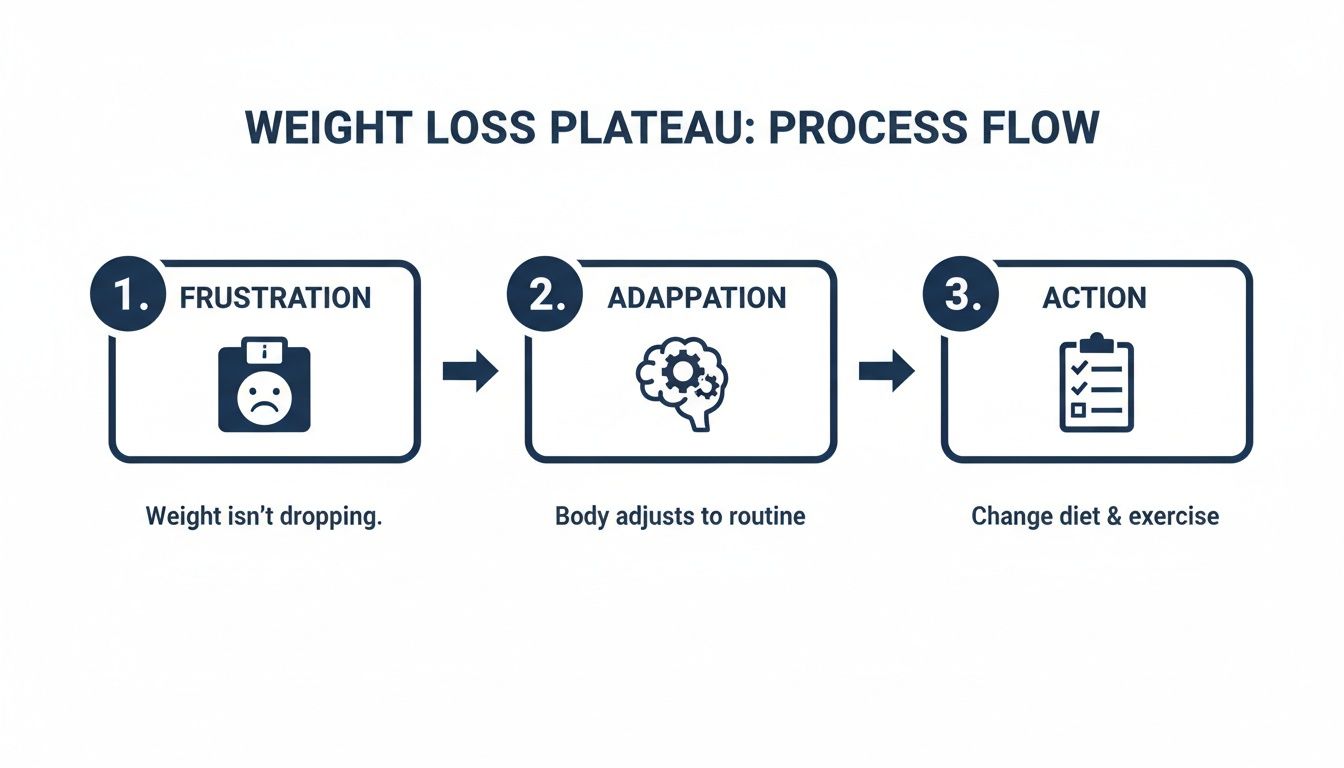
This process shows that the real key is moving from that "stuck" feeling to a problem-solving mindset.
Ready to figure out what your next move should be? At Blue Haven Rx, we specialize in providing medical guidance and support that can make all the difference. If you feel you’ve tried everything, it might be time for a personalized plan. Take our quick quiz to see if you are a candidate.
Why Your Metabolism Puts on the Brakes
It's one of the most frustrating moments in any weight loss journey: the scale just stops moving. You might feel like your body has suddenly decided to work against you. In a way, you're not wrong. This is a brilliant, built-in survival tool called metabolic adaptation.
As you lose weight, your body becomes lighter and more efficient. It learns to run on less fuel, essentially protecting you from what it perceives as a famine. Your metabolism naturally slows down to conserve energy.
This isn’t a failure on your part. It's actually a testament to your body's amazing ability to adjust. The trick is to understand this biological process so you can work with it and get things moving again.
The Science of a Slower Burn
So, what’s happening under the hood? Metabolic adaptation affects you in two specific ways. First, your Basal Metabolic Rate (BMR)—the calories you burn just by being alive—goes down. It makes sense: a smaller body simply needs less energy to maintain itself.
But there's another, sneakier side. Your body also gets crafty about reducing the calories you burn through everyday movements, and this often happens subconsciously.
This is all tied to a concept called Non-Exercise Activity Thermogenesis (NEAT). NEAT is the energy burned for everything you do outside of sleeping, eating, or dedicated exercise.
Here’s how it plays out:
- Before weight loss: You might have been a natural fidgeter, tapped your feet while sitting, or paced while on the phone.
- After weight loss: To save precious calories, your body subtly dials back all those little movements without you even noticing.
This one-two punch of a lower BMR and reduced NEAT is often what leads directly to a plateau. The calorie deficit that was working wonders a few weeks ago might now just be your new maintenance level.
Putting Numbers on the Metabolic Slowdown
The effect of this adaptation is bigger than most people think. For many people making lifestyle changes, weight loss predictably slows or stops right around the six-month mark. This is when these metabolic adjustments really kick in.
Losing just 10% of your body weight can reduce your total daily energy expenditure by a surprising 20-25%. A huge chunk of that drop comes from the decrease in those subconscious NEAT movements, making the plateau a very real biological hurdle.
Your body is simply trying to find a new equilibrium, or "set point." This isn't a personal failing; it's a biological reality. Knowing this lets you adjust your strategy without the self-blame.
If you’re worried your metabolism might be slower than it should be, it’s worth looking into the signs. You can get familiar with the common symptoms of a slow metabolism in our guide.
Hormones Join the Conversation
It’s not just about calories and movement; your hormones get in on the act, too. As you lose weight, specific hormonal shifts can make breaking through a plateau even tougher.
- Leptin, the hormone that signals to your brain that you're full, tends to drop.
- Ghrelin, the "hunger" hormone, often revs up, making you feel hungrier.
This hormonal cocktail means you might feel less satisfied and more ravenous than you did at the start of your journey, even on the same amount of food. It’s another layer of your body’s defense system to halt weight loss.
Understanding that metabolic adaptation, NEAT, and hormones are all working in concert is the key. It allows you to stop fighting your body and start working with it. By using targeted strategies, you can gently nudge your metabolism back in the right direction.
If you think these factors are behind your stall, Blue Haven Rx can help you figure out the next steps. Start your journey by taking our simple online quiz today.
Fine-Tuning Your Nutrition to Reignite Progress
When the scale has stopped moving, it's frustrating, but it's also a completely normal part of the process. What worked for the first 10 or 20 pounds often needs a little tweaking to get you to the next stage. Your body has simply adapted, and the calorie deficit that was once working has likely shrunk.
This isn't a sign to panic or slash your calories. Instead, it’s time for a smart, strategic adjustment. Let's look at how to fine-tune your diet to get things moving again, focusing on sustainable habits for long-term health.

Prioritize Protein to Preserve Muscle
As we lose weight, especially over age 45, holding onto lean muscle is essential. It's the engine that powers your metabolism. When you're consistently eating in a calorie deficit, your body can start breaking down precious muscle tissue for energy—the exact opposite of what we want.
Protein is your number one defense. It not only helps protect that muscle, keeping your metabolism humming, but it also has a powerful effect on satiety. Eating enough protein helps you feel fuller for longer, so you can naturally manage hunger without constantly fighting cravings.
Key Takeaway: Think of protein as the anchor of your plateau-busting plan. It protects your metabolism and helps you feel satisfied on fewer calories. It’s a win-win for weight management and healthy aging.
The goal is simple: include a solid source of protein in every meal.
- Breakfast: Instead of just toast, add a couple of scrambled eggs or a scoop of Greek yogurt.
- Lunch: Make sure your salad has a real star, like grilled chicken, a can of tuna, or a generous portion of chickpeas.
- Dinner: Aim for a palm-sized portion of fish, lean meat, or tofu on your plate.
Combat the Slow March of Calorie Creep
One of the sneakiest culprits behind a stalled scale is "calorie creep." It’s that slow, almost unnoticeable increase in portion sizes that happens over weeks. A little extra olive oil in the pan, a handful of nuts that’s a bit more generous than it used to be—it all adds up.
It’s completely human. After diligently measuring everything, we start to eyeball portions. But what we think is a tablespoon might have slowly morphed into two. These little extras can quietly erase the calorie deficit needed for weight loss.
The best way to get back on track is to pull out the measuring tools for a week. Grab your measuring cups and a food scale and do a quick "audit." This isn't about being obsessive forever; it's about recalibrating your eyes and ensuring your portions are accurate. Using one of the best food diary apps for easy nutrition tracking during this time can give you incredible clarity.
Focus on Nutrient Density, Not Severe Restriction
Making another drastic cut to your daily calories might seem like the obvious answer, but it can easily backfire. Your metabolism can slow down even further, and you'll likely just end up feeling drained, hungry, and miserable.
A much smarter, more sustainable approach is to focus on nutrient density. This simply means getting the most nutritional value for your calories.
You want to fill your plate with whole, unprocessed foods packed with vitamins, minerals, and fiber. These are the foods that truly satisfy you and give your body the high-quality fuel it needs to function optimally, supporting both weight management and longevity.
Simple Swaps for Better Nutrient Density:
| Instead Of This... | Try This... | Why It Helps Break a Plateau |
|---|---|---|
| White Rice | Quinoa or Brown Rice | More fiber and protein keep you fuller longer, stabilizing blood sugar. |
| Sugary Cereal | Oatmeal with Berries | Provides sustained energy and fiber without the sugar crash and subsequent cravings. |
| Creamy Dressings | Vinaigrette or a squeeze of Lemon | Significantly lowers calorie and unhealthy fat intake without sacrificing flavor. |
| Fruit Juice | A piece of Whole Fruit | Delivers fiber to slow down sugar absorption, promoting better satiety. |
Making these small but powerful shifts can be all it takes to reignite your progress without resorting to extreme measures. It’s an approach that supports your overall health for the long haul.
If you’ve dialed in your nutrition and are still feeling stuck, it might be time to look at how your biology is playing a role. Blue Haven Rx offers personalized medical support that can complement your lifestyle efforts. Learn more by starting our quick online quiz.
Shaking Up Your Movement Routine
That trusty exercise plan that helped you lose the first 20 pounds? It might not be the right one to get you over the finish line. This is a totally normal and expected part of the journey. As you get lighter and fitter, your body becomes more efficient, burning fewer calories to do the exact same work.
To bust through a plateau, the answer isn't always to work harder—it's to work smarter. It's time to evolve your routine and give your body a new challenge it isn't used to. This is how you wake up your metabolism and get things moving again.

Embrace Strength Training for a Metabolic Edge
Cardio is fantastic for your heart, but when the scale won’t budge, strength training is your best friend. Building lean muscle is especially important as we get older because muscle tissue is far more metabolically active than fat. In simple terms, it burns more calories around the clock, even when you're just sitting on the couch.
If you lose muscle while dieting—which is common—your metabolism can take a nosedive. By adding resistance training 2-3 times per week, you’re telling your body to hold onto that precious, calorie-burning muscle. You don't have to live in the gym, either. Bodyweight exercises, resistance bands, and a set of light dumbbells can do wonders.
Practical Tip: Think of muscle as your body's metabolic engine. The bigger the engine, the more fuel (calories) it burns all day long. This makes it so much easier to maintain your weight in the long run.
Mix It Up with High-Intensity Intervals
If your daily walk has become a mindless routine, your body has probably adapted. A great way to break through the monotony and the plateau is to introduce High-Intensity Interval Training, or HIIT. This just means alternating short bursts of intense effort with brief periods of rest or easier activity.
The beauty of HIIT is its efficiency. You can get a powerful, calorie-torching workout in a fraction of the time. Instead of a steady 30-minute jog, you could try walking at your usual pace for three minutes, then picking it up to a power walk for one minute. Just repeat that cycle.
A Few HIIT Ideas to Get You Started:
- On the Bike: Pedal comfortably for 2 minutes, then go all-out for 30 seconds. Repeat 8 times.
- Out for a Walk: Stroll for 3 minutes, then jog or walk as fast as you can for 1 minute. Keep this up for 20-25 minutes.
- At Home Circuit: Do 45 seconds of jumping jacks, rest for 15. Then 45 seconds of high knees, rest for 15. Mix in other moves like squats or push-ups against a wall.
Keeping your body guessing like this prevents it from getting too comfortable, which is exactly what you need to push past a plateau.
Don't Underestimate NEAT
Your scheduled workout is just one part of the equation. A huge chunk of the calories you burn every day comes from something called Non-Exercise Activity Thermogenesis (NEAT). It’s a technical term for all the movement you do that isn't formal exercise—fidgeting, walking to the mailbox, taking the stairs, you name it.
Boosting your NEAT is a surprisingly powerful way to get the scale moving again. It’s all about weaving small bits of activity into your day. These little things really add up.
Here are a few practical tips to increase your daily NEAT:
- Always take the stairs.
- Park in the farthest spot from the store entrance.
- Pace around the room when you're on a phone call.
- Do a few stretches or walk in place during TV commercials.
- Add a quick 10-minute walk after your evening meal.
By revitalizing your workouts and your everyday movement, you create a powerful combination that can break through even the most stubborn stall. For a deeper dive into how exercise specifically targets problem areas, check out our guide on how to reduce belly fat.
If you’ve tried all this and still feel stuck, it may be time to look at how your own biology is playing a role. Blue Haven Rx offers personalized medical support to help you finally see the results you deserve. Take our quick online quiz to find out if a medical weight loss program could be the right next step for you.
The Sneaky Saboteurs of Your Weight Loss
Sometimes, the scale grinds to a halt for reasons that have nothing to do with what you're eating or how much you're exercising. You can have your nutrition and workouts dialed in perfectly, but if you ignore key lifestyle factors, you'll stay stuck.
These are the hidden culprits that can quietly bring your progress to a dead stop. Things like poor sleep, chronic stress, and not drinking enough water can be just as powerful as the calories you're counting.
Let's pull back the curtain on these three areas. Addressing them isn't just about breaking through a plateau; it's about building a foundation for your overall health that will last a lifetime.
Sleep: The Non-Negotiable Metabolism Booster
Think of sleep as a critical part of your fat-loss toolkit, not a luxury. When you consistently get less than 7-9 hours of quality sleep a night, you're throwing your body's hormones completely out of whack.
This isn't just about feeling tired. It directly impacts two crucial hormones that control your appetite:
- Ghrelin: This is your "go-eat-something" hormone. When you're sleep-deprived, ghrelin levels spike, making you feel ravenous, even when your body doesn't need the calories.
- Leptin: This is the hormone that tells your brain, "I'm full, stop eating." When you don't sleep enough, leptin levels plummet.
You're left fighting a losing battle against your own biology—you feel hungrier, never feel quite satisfied, and your brain starts screaming for a quick energy fix from sugary, high-calorie foods.
Stress and the Cortisol Connection
We all deal with stress. But when that stress becomes a constant companion, your body cranks up the production of a hormone called cortisol. In short bursts, cortisol is essential for our survival. When it’s always high, it's a major roadblock for weight loss.
Elevated cortisol does a couple of things, neither of them good for your goals. It ramps up your appetite, especially for "comfort foods" loaded with fat and sugar. It also sends a signal to your body to hang onto fat, particularly around your belly, as a form of emergency energy storage.
Feeling constantly drained and overworked? Chronic stress and burnout can be massive roadblocks. Understanding the impact of burnout on your weight loss progress is a crucial first step toward getting things moving again.
Finding simple ways to de-stress is just as important as any workout you do. A calmer mind makes for a healthier body, and it might just be the secret weapon you need to break through a stubborn plateau.
Don't Underestimate the Power of Water
Hydration is everything. Every single process in your body, especially your metabolism, depends on it.
When you're even mildly dehydrated, your metabolic rate can slow to a crawl as your body tries to conserve every last drop of fluid. A sluggish metabolism means you're burning calories less efficiently, period.
Water is also a secret weapon for managing hunger. Our brains are notoriously bad at telling the difference between thirst and hunger. Often, that craving for a snack is actually your body crying out for a glass of water. Staying hydrated helps you feel fuller and makes it easier to listen to your body's real needs.
A practical tip is to keep a water bottle with you all day. If you wait until you feel thirsty, you're already behind.
By getting your sleep, stress, and hydration in order, you're creating an internal environment where weight loss can happen more easily. If you’ve addressed these lifestyle factors and are still stuck, it might be time to look at how your own unique biology is playing a role.
At Blue Haven Rx, we help you connect all the dots. Take our quiz today to see if a personalized medical approach is the support you've been missing.
When to Consider Medical Support for a Tough Plateau
It's one of the most frustrating feelings in the world: you've done everything right. You've dialed in your nutrition, you're consistent with your workouts, and you're even managing your sleep and stress. But that number on the scale just won't budge.
When you've hit that wall, especially for those of us over 45 dealing with hormonal shifts, you're often up against more than just calories and exercise. You're fighting your own biology.
This is the exact point where modern medicine can offer a powerful assist. It's not about finding an "easy way out" or replacing all your hard work. It’s about adding a tool that finally allows your efforts to pay off by working with your body's systems, not against them.
What Advanced Prescription Options Can Do
When lifestyle changes alone aren’t enough to break through, advanced therapies can be a game-changer. Medications in the GLP-1 class—such as Semaglutide and Tirzepatide—address the deep-seated biological factors that make weight loss feel like an uphill battle.
These aren't just simple appetite suppressants. They work on a more fundamental level, sending signals to your brain that help you feel full and satisfied, effectively turning down the "food noise." They also play a huge role in supporting your overall metabolic health, which is essential for not just losing weight but keeping it off for good.
Think of it this way: medical support can help quiet the hormonal static and persistent cravings, clearing the way for your healthy habits to finally produce the results they should.
Getting Care That's Simple and Supportive
The thought of starting a prescription might seem intimidating, but modern telehealth has completely changed the game, making the process incredibly straightforward and private. Here at Blue Haven Rx, we’ve built a simple pathway to find out if this is the right next step for you. It’s all about giving you access to a safe, effective tool to help you reach your goals.
Getting started is designed to be as seamless as possible:
- Take a Quick Quiz: It all starts with a simple online quiz from the comfort of your home to see if you might be a good candidate.
- Talk to a Doctor: Next, you'll have a private consultation with a licensed U.S. doctor. They’ll go over your health history and figure out a personalized plan that makes sense for you.
- Get Your Medication Discreetly: If a prescription is a good fit, your medication is shipped directly to you. No insurance headaches, no pharmacy lines, and no hidden fees.
You can get a deeper understanding by reading our guide on the different types of prescription weight loss medication available.
Sometimes, pushing through a stubborn plateau takes more than just sheer willpower. Adding a scientifically-backed medical tool to your plan can help you break free from the frustration and get back on track toward feeling your best.
Ready to find out if this could be the missing piece for you? Start by taking the Blue Haven Rx quiz today.
Got Questions About Your Weight Loss Plateau?
When you hit a weight loss stall, it's natural to have questions. Let's tackle some of the most common ones we hear.
How Long Is This Plateau Going to Last?
Honestly, it varies. A typical weight loss plateau can stick around for a few weeks or even a couple of months. Think of it as your body's "check-in" period—it's adjusting to your new, lower weight and trying to find a new balance.
If you’ve been consistent with your plan and the scale hasn't budged for four weeks or more, that’s your cue to dig a little deeper into what might be going on.
Is It Time to Drastically Cut My Calories?
Please don't. Slashing your calories to almost nothing is one of the biggest mistakes you can make. It often backfires by slowing your metabolism down even further and can cause you to lose valuable, calorie-burning muscle mass.
A much smarter move is to make small, strategic tweaks. Instead of extreme restriction, try bumping up your protein intake, adding more fiber-rich veggies, or switching up the intensity of your workouts.
Could a Medical Issue Be the Real Problem?
Yes, absolutely. Sometimes, no amount of diet and exercise will move the needle if there's an underlying medical issue at play. Things like a sluggish thyroid or hormonal imbalances are well-known culprits for stalled weight loss. Certain medications can also make it incredibly difficult to lose weight.
If you feel like you've tried everything and you're still stuck, getting a medical evaluation is a really smart next step. Convenient telehealth services like Blue Haven Rx make it easy to talk to a licensed doctor and explore all the potential factors, right from your home.
At Blue Haven Rx, we understand how frustrating it is when your hard work isn't paying off. Our team is here to offer the medical insight and support that can help you finally break through that stubborn plateau and get back on track to your health goals.
Ready to see what a personalized plan could do for you? Start your journey and learn more with Blue Haven Rx today.